
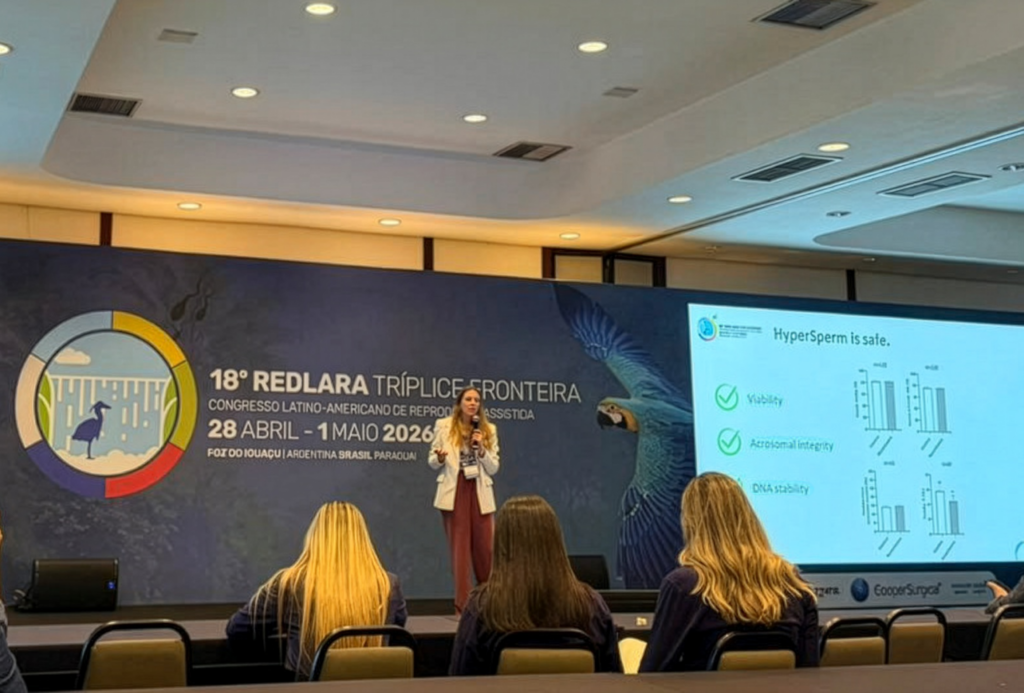
Fecundis participated in the 18th REDLARA 2026 Triple Frontier Congress, held in Foz do Iguaçu, Brazil, from April 28 to May 1, 2026.
REDLARA is one of the most relevant scientific meetings for assisted reproduction in Latin America, bringing together clinicians, embryologists, researchers, and fertility professionals from across the region.
During the congress, our researcher Guillermina María Luque, presented the oral communication “Higher Blastocyst Formation and Euploidy Rates Using HyperSperm in IVF and ICSI Cycles”.
New clinical evidence across IVF and ICSI cycles
The presentation shared results from a prospective, multicenter sibling-oocyte study evaluating HyperSperm in IVF and ICSI cycles. The study included 58 couples treated across four clinics (Pregna Medicina Reproductiva, Fertya Medicina Reproductiva, In Vitro Buenos Aires and WeFIV) between August 2023 and December 2025. Sibling oocytes were divided between standard sperm preparation and the HyperSperm protocol, allowing a direct comparison within the same treatment cycle.
Fertilization rates were comparable between groups in both IVF and ICSI cycles. Regardless of the fertilization method, HyperSperm resulted in a greater number of blastocysts per cycle compared with Control, with higher blastocyst rate per fertilized oocyte in IVF (55.6% vs. 46.9%) and ICSI (73.4% vs. 66.1%).
This advantage extended to embryo competence: the euploidy rate was significantly higher in embryos derived from HyperSperm-treated sperm compared with conventional preparation (50.0% vs. 30.4%, p=0.03), an improvement observed consistently in both IVF (53.1% vs. 31.3%) and ICSI (45.8% vs. 26.9%) cycles.
These findings support the role of sperm function and capacitation as clinically relevant factors in embryo development, across both IVF and ICSI settings.
Strengthening HyperSperm’s clinical validation
Presenting these data at REDLARA was an important step for Fecundis and for the growing clinical validation of HyperSperm.
The congress offered a unique space to discuss the results with the Latin American reproductive medicine community, where scientific innovation and real clinical practice are closely connected.
We are grateful to the REDLARA organizing committee, to the moderators of the session, and to all the professionals who contributed to the scientific exchange around HyperSperm and the future of sperm preparation in assisted reproduction.