
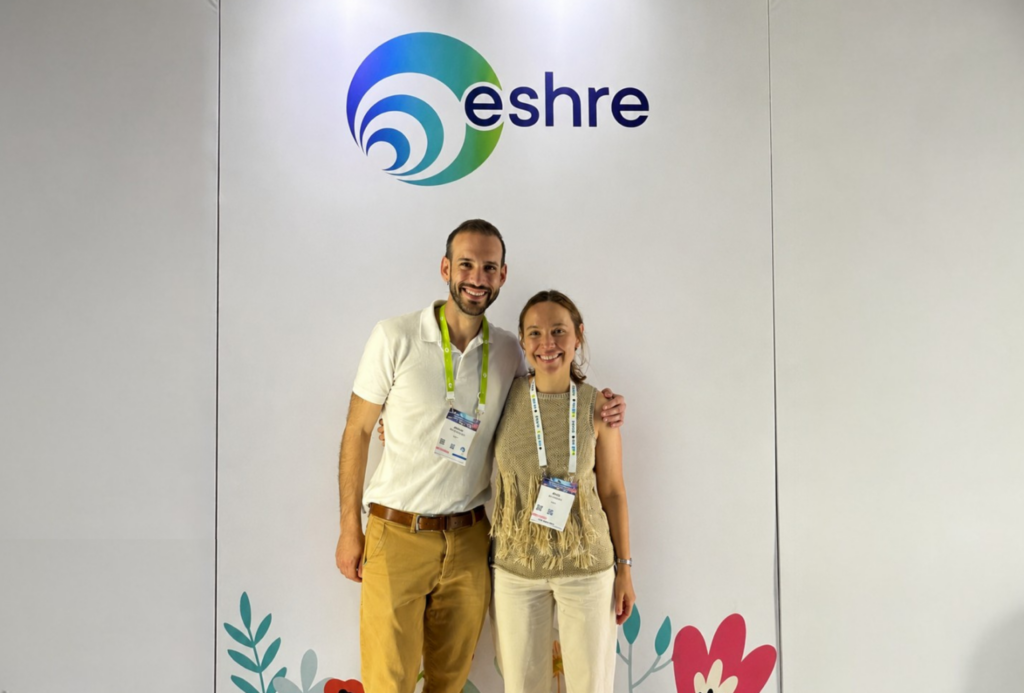
ESHRE 2026 in London was an important moment for Fecundis.
Over three intense days, our CEO Arina Rogozina and COO Matías Gómez Elías joined clinicians, embryologists, researchers, fertility clinics, and industry partners from across the reproductive medicine community.
For us, ESHRE was more than a scientific congress. It was an opportunity to listen, exchange ideas, and discuss a question that is becoming increasingly relevant in IVF: how can we better address the male side of fertility treatment?
In assisted reproduction, major advances have transformed ovarian stimulation, embryo culture, genetic testing, cryopreservation, and laboratory workflows. Yet sperm preparation remains focused on conventional parameters such as concentration, motility, and morphology.
These parameters are essential, but they do not fully capture sperm function.
At ESHRE, this message resonated strongly. Across meetings and conversations with fertility professionals, we saw growing interest in technologies that move beyond sperm recovery and selection toward a deeper understanding of sperm physiology, capacitation, and functional competence.
A growing need in the IVF laboratory
For many IVF laboratories, sperm preparation is a familiar and highly standardized step. Methods such as density gradients and swim-up are widely used to isolate motile sperm before fertilization. However, these approaches do not fully reproduce the biological process that sperm undergo naturally before interacting with the oocyte.
This gap is where Fecundis is focused.
Our work is based on the idea that sperm cells are not passive carriers of DNA. They are biologically active cells that must acquire functional competence before fertilization. Capacitation, hyperactivation, membrane remodeling, and sperm-oocyte interaction are all part of a complex process that can influence fertilization and embryo development.
Conversations that confirmed the direction
During the meeting, we discussed HyperSperm, our sperm capacitation technology, with professionals from different areas of reproductive medicine. These conversations confirmed just how relevant this perspective has become for the field. Clinicians and embryologists are looking for practical, evidence-based tools that can help improve IVF outcomes without adding complexity to the laboratory workflow.
The feedback was highly encouraging. Many conversations focused not only on the clinical data, but also on a broader need: to rethink how we understand sperm function in ART.
For Fecundis, this was especially meaningful. It showed that the reproductive medicine community is open to new approaches that focus on sperm function beyond conventional sperm parameters, recognizing it as a clinically relevant factor in IVF.
It also reinforced an important idea: improving fertility treatment is not only about generating more data. It is about translating biological knowledge into solutions that fit real clinical workflows and support better decision-making in the laboratory.
The male gamete deserves more attention
One of the clearest takeaways from ESHRE 2026 was that sperm biology is gaining visibility, but there is still a significant opportunity to turn that knowledge into clinical impact.
For too long, the male contribution to embryo development has often been reduced to basic semen parameters or to the ability of a sperm cell to fertilize an oocyte. Today, growing evidence suggests that sperm function may play a more active role in embryo quality and reproductive outcomes.
This does not replace the importance of oocyte quality, embryo culture, clinical factors, or patient-specific variables. But it does support a more complete view of assisted reproduction: one in which sperm function is recognized as a meaningful part of the equation.
Looking ahead
We left London with renewed energy and a clearer sense of where the field is heading.
ESHRE 2026 confirmed that there is a real need for new tools to improve sperm function: science-based solutions that are easy to integrate into the laboratory and designed to have an impact on clinical practice.
At Fecundis, we remain committed to transforming knowledge of sperm biology into concrete solutions that help improve embryo development and expand the clinical options available to patients during IVF treatment.
We are grateful to everyone who met with us, visited our poster, shared feedback, and helped make ESHRE 2026 such a valuable milestone for Fecundis.
Until next year, ESHRE.