
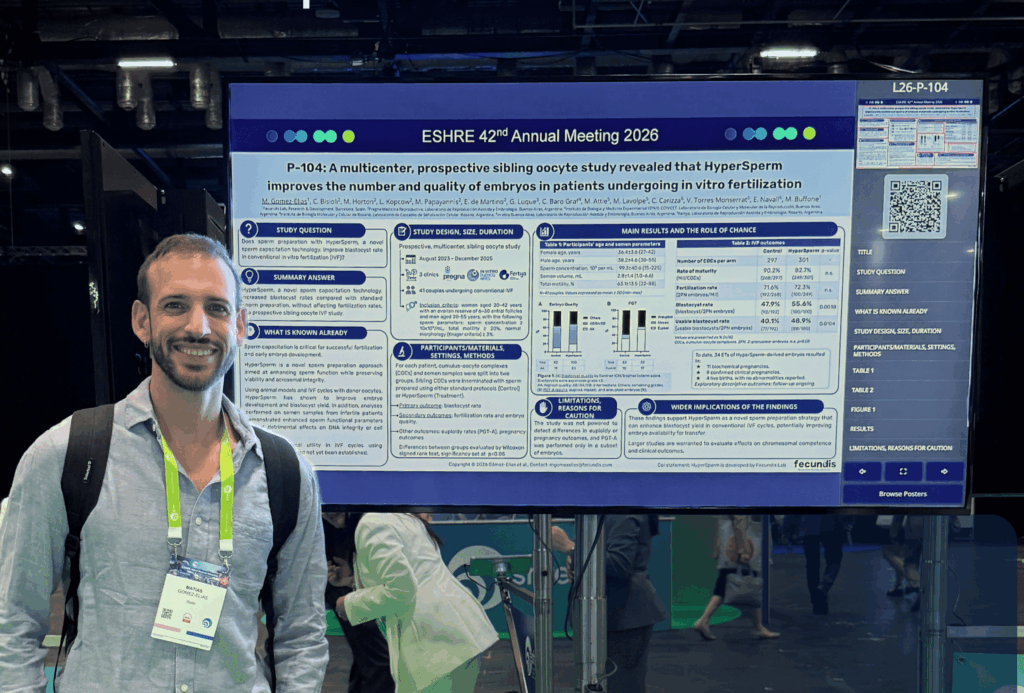
Fecundis presented the latest clinical evidence on HyperSperm at ESHRE 2026 in London, one of the key international meetings for reproductive medicine and embryology.
Our poster, titled “A multicenter, prospective sibling oocyte study revealed that HyperSperm improves the number and quality of embryos in patients undergoing in vitro fertilization”, was presented by Matías Gómez Elías, COO of Fecundis, in the Andrology session (P-104).
The study conducted in collaboration with three fertility clinics in Argentina (Pregna Medicina Reproductiva, Fertya Medicina Reproductiva, and In Vitro Buenos Aires) evaluated HyperSperm in conventional IVF cycles using a multicenter, prospective sibling-oocyte design.
Discussing the latest clinical results
The multicenter study included 41 couples undergoing conventional IVF. For each patient, sibling oocytes were divided between two conditions: standard sperm preparation and the HyperSperm protocol.
This design allowed the study to compare both sperm preparation approaches within the same treatment cycle, reducing variability between patients and providing a clearer view of the potential impact of HyperSperm on embryo development.
The results showed that preparing sperm with HyperSperm increased blastocyst development compared with standard sperm preparation. The HyperSperm group also showed a higher rate of usable blastocysts, meaning embryos with transfer or cryopreservation potential.
Additionally, in a subgroup of embryos analyzed by PGT-A, a higher proportion of euploid embryos was observed in the HyperSperm group, opening a particularly promising line of exploration for future studies.
A scientific discussion around sperm function
Presenting these results at ESHRE gave us the opportunity to discuss HyperSperm with clinicians, embryologists, researchers, and fertility professionals from different countries.
The conversations went beyond the numerical results. They focused on a broader question that is becoming increasingly relevant in IVF: how can semen preparation better support sperm function?
This is especially important because conventional sperm preparation methods mainly focus on recovering motile sperm. HyperSperm is based on a different approach: supporting sperm capacitation, the biological process that functionally prepares sperm before fertilization.
Collaboration behind the data
The poster also represented the work of a broad collaborative team across Barcelona, Buenos Aires, and Rosario.
We were especially pleased to involve embryologists and clinicians from our collaborating centers in the discussions around the study. Their experience in daily IVF practice adds essential context to the data and helps connect the scientific results with real laboratory workflows.
For Fecundis, sharing this work at ESHRE was an important step in showing how sperm function can become a clinically relevant factor in IVF.
We are grateful to everyone who discussed the results with us and contributed to a valuable exchange around the future of sperm preparation in assisted reproduction.